
Spirit of Joy

(©Shamim-stock.adobe.com)
Just as Clark Kent works as a mild-mannered reporter by day and is Superman by night, Tanisha Rinehardt shines as an assistant controller at a prominent law firm by day and reigns as Philadelphia’s double Dutch jump rope queen by night. “By day, my career is in finance and accounting,” she says. “Philly Girls Jump is my 5 to 9.”
Rinehardt’s 5 to 9 started almost exactly 10 years ago when she and a friend were tossing around ideas to become more active and have fun. “We were just talking about ways we can get our bodies moving again, so we said, ‘Let’s jump double Dutch like we used to.’ We set up a Facebook post and we were hoping to get five to 10 of our friends and meet up and jump rope in a park for fun. Over 2,000 people showed up,” she remembers of the ‘launch’ of Philly Girls Jump.
Prior to that first meetup, the women realized just how viral their post had gone, so they “decided to put some structure behind it,” securing a DJ, hiring food vendors, and spreading the word among local artisans to come sell crafts — “just like an old school block party. It was a lot of fun,” Rinehardt remembers.
From that first day, Philly Girls Jump (now often referred to as PGJ) has grown steadily into a beloved Philly institution with thousands of fans and participants throughout the year. “We do everything,” says Rinehardt. “We are even in many places where you may not typically think that double Dutch ropes belong.” Examples include famous art and history museums, the Philadelphia Convention Center, city-wide parades, and corporate and private parties.
As the group grew, everything didn’t always go smoothly, but they persevered — when Rinehardt’s friend and co-founder moved away, “we didn’t stop. We kept going and got even stronger,” she says. Luckily, another friend, Rasheeda McQueen, jumped in to help keep Philly Girls Jump moving forward, finding time to work with the group while maintaining a career as a realtor. Kenneth Jones, a college professor and double Dutch champion, also recently came onboard as an instructor, similarly balancing his career with his time in the ropes.
The professional diversity of the group’s leaders is echoed in the diversity of PGJ participants, as they enthusiastically welcome all jumpers, regardless of experience, age or gender. “Philly Girls Jump may have been started by two girls from Philly, but our ropes are open to anyone who wants to experience the fun and joy of double Dutch,” Rinehardt stresses.
The group is solidly intergenerational, actively encouraging jumpers of all ages. “We don’t have an age minimum or maximum. We have grandmothers out there with their granddaughters, we have fathers out there with their daughters, we have everyone. … There’s a lot of people a lot younger than me and a lot of people a lot older than me who still jump. On our Instagram page (@phillygirlsjump) there’s a lady this summer jumping with us who
I believe is in her 70s. She did great!”
Weekly meetups typically last around two hours, with the first half dedicated to teaching any newcomers, followed by an open jump session. Meetups are often on Wednesday, Thursday or Friday as well as during community events on weekends throughout the summer.
“We have developed a technique to teach double Dutch in less than a minute. It works for anyone, literally. If you can jump up and down, we can teach you to double Dutch jump rope,” Rinehardt says. “It works. It works.”
In addition to physical and cognitive benefits, PGJ participants also reap psychological and social benefits. “People always say that double Dutch is their therapy,” reports Rinehardt. “Growing up, it was a way for us to organically make friends. So many people have made friends here that have morphed into family. You see these people from week to week, and you start to look forward to seeing them and you form a bond and a relationship with them that grows outside of the ropes.”
PGJ counts several cancer survivors in their ranks. They and others see the group as the place to heal their bodies and their souls, returning week after week for the camaraderie, the exercise and the acceptance of meeting people where they are and growing together.
In a typical week, 20 to 25 people participate, but PGJ also produces two giant community events at which hundreds or even thousands may show up. These events are held at the beginning and end of the warmer weather: The first Saturday in May, now officially known as Philly Double Dutch Day as proclaimed by the Philadelphia City Council, is marked with a major event, and the last Saturday of the summer is typically the Philly Double Dutch Knockout event.
Both events have sponsors, prizes, giveaways, food, music and more, with other double Dutch groups coming to participate from as far away as Chicago and New York. “The difference between the weekly meetups and the events that we produce are we bring the vendors in; we create a whole atmosphere of fun. It’s more than just jumping … those are more like double Dutch festivals, and our weekly meetups are practice for that. So when we have the bigger events, this is your time to show off. For Double Dutch Knockout we even have a pink boxing ring, and everybody wants to be the best and get the bragging rights.” There are also prizes and awards.
When asked what’s next for Philly Girls Jump, Rinehardt pauses. “I always like to say that even though we have goals, everything we’ve done has already exceeded my wildest expectations for Philly Girls Jump. From the places that we go to the people that we meet to the events that we have. Our mission is not only to empower the spirit of joy but also to build community. And we’re doing all that and more.” n
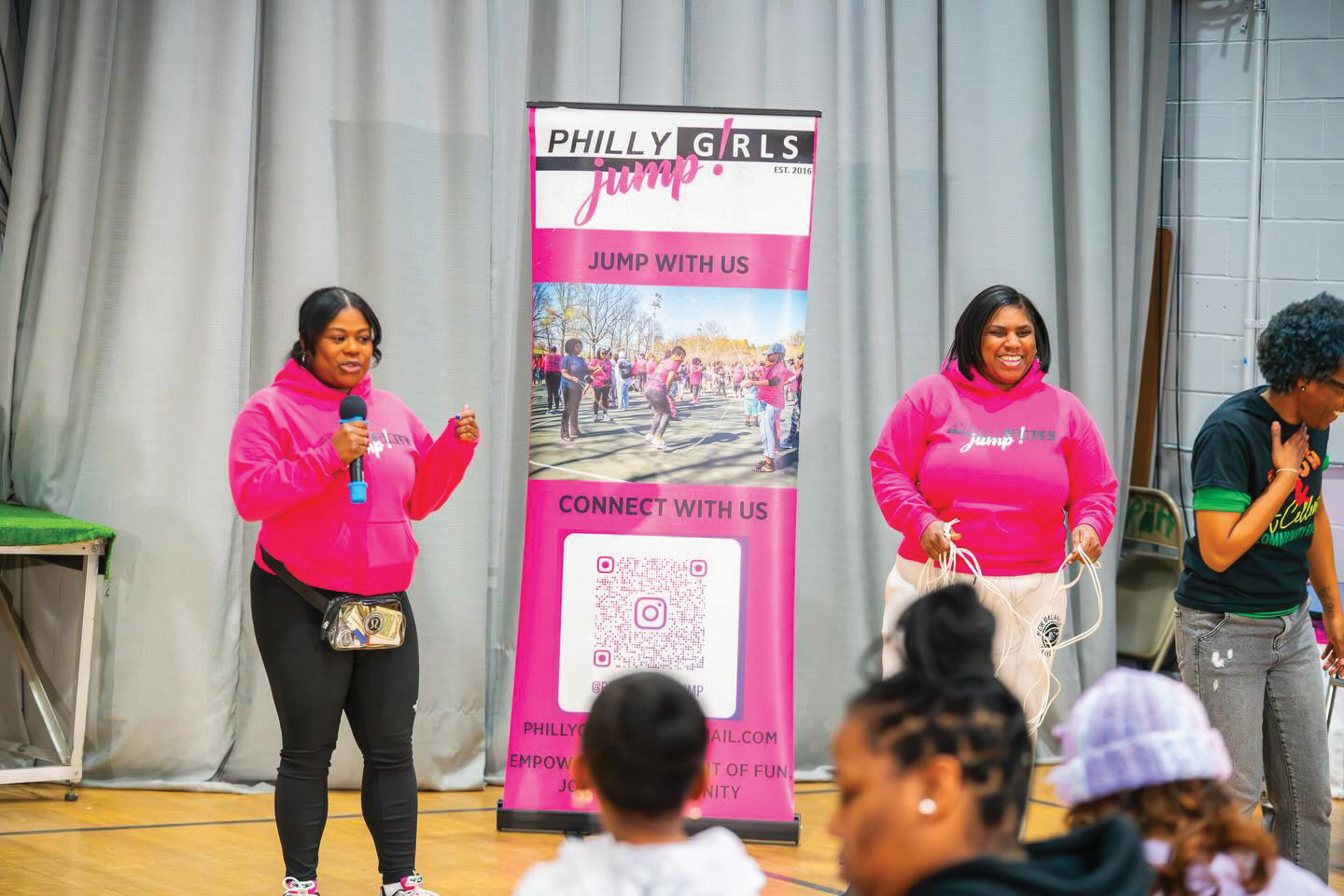
Tanisha Rhinehardt and co-founder Rasheedah McLean promote Philly Girls Jump. (Photo courtesy of Philly Girls Jump)