
Party on Two Wheels
According to Coach Sam Balto, co-founder of the nonprofit Bike Bus World, a bike bus is very much akin to a Swiss Army knife — a multipurpose tool known for its usefulness and adaptability. A little something for everyone.
“Some people do it for the climate, some people do it for the physical activity, some people do it for joy, and now people are getting organized to create safety in numbers to help kids get to school,” Balto elaborates. Basically, in all cases, a bike bus is an organized group ride on a designated route with meeting times, but
different people join for different reasons.
Balto was inspired to launch his first bike bus after seeing one in Barcelona, Spain, in 2021. He had already been organizing walking school buses in schools in the U.S., so the transition to bike buses was easy. He continued teaching and running his own bike bus for approximately five more years and recently left teaching altogether to run the nonprofit Bike Bus World full-time.
Although Bike Bus World functions as an umbrella organization helping to support and amplify bike buses around the world, no one needs to contact them to start a bike bus. “You don’t need permission to start a bike bus,” says Balto. “You just need a few neighbors who want to ride together. … No one invented riding your bike to school.” Just in the past year, Balto visited 13 bike buses in locations as far flung as Vienna, Austria; Wales in the U.K.; and in towns and cities in the U.S. from states including California, Texas, Virginia, Florida and New Jersey.
To start a bike bus, all people need is a willingness to volunteer and a few friends or neighbors to help out. The route needs to be planned out and a schedule created. Some bike busses run weekly, some monthly and some seasonally — whatever works for the leader and the community. In general, bike buses exist to get kids to school in a safe and fun way — they’re not meant
to replace school buses, or even to operate in two
directions, five days per week.
If anyone loves the idea of a group of kids getting together in an organized way to get to school, but biking might be a challenge, Balto advises that they can start a walking school bus, rather than a bike bus. “Start building that community cohesion and then gradually, over time, work as a group and remove barriers. Bike storage is a big issue, either at school or where people live,” he explains. “And even access to bikes can be a challenge.”
But once a bike bus is started, the benefits to the community are off the charts. In addition to the obvious physical benefits for those involved, children who participate in bike buses gain skills, confidence and have better attendance rates on bike bus days. “A lot of schools are dealing with absenteeism, and so schools use a bike bus as a way to help kids get to school,” says Balto. In fact, several school districts have intentionally used bike buses as a tool to increase attendance by scheduling them on days with the lowest attendance, and they have then seen attendance spike on those days.
“We hear all the time that participation in a bike bus also builds kids’ confidence. It gives them a sense of pride,” Balto continues. “Also, it’s really hard to know how to give your kids independence, and the bike bus is a great tool for parents.” As a father of elementary school-age children himself, Balto understands the challenges that many parents face in this area.
Anecdotal evidence also suggests that children are learning how to ride a bike specifically so that they can participate in their local bike bus. Balto had heard that from parents along his own bike bus route in Portland, Oregon, and when he posted on social media about it, other leaders commented that they had heard the same thing in their groups. “If you think about it, if in every bike bus all over the world, five kids are learning how to ride so they can participate, and bike buses are doubling every year — which they are — that’s a ton of kids learning how to ride bikes.”
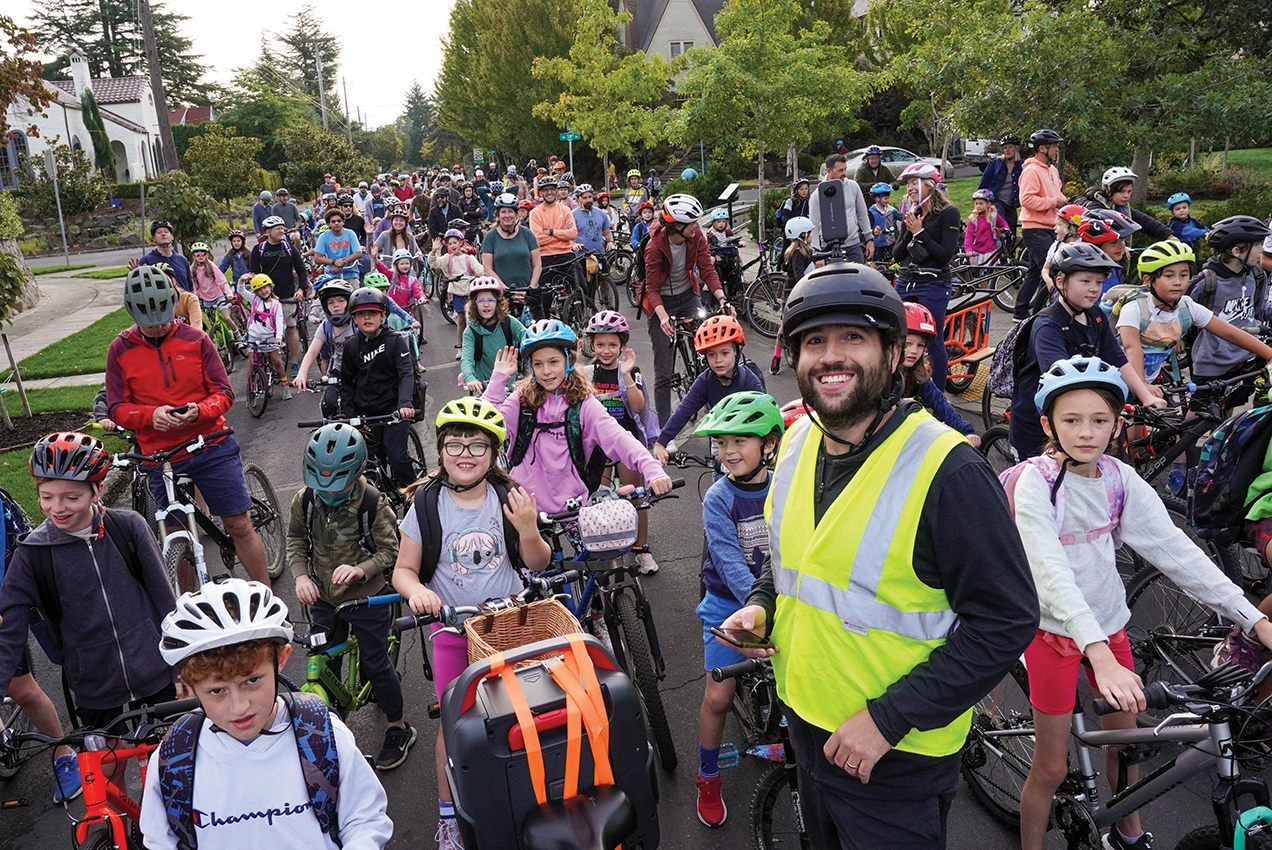
Sam Balto leads Alameda Elementary School’s bike bus in Portland, Oregon. (Photo: Jonathan Maus/BikePortland)
Creating Change
Bike buses are inherently joyful and fun, but most leaders also incorporate a few standard tricks of the trade to raise the fun quotient even more. Music is “super joyful, good energy … and creates a positive vibe that keeps people coming back. Music and bubbles. People really love bubbles,” says Balto. Bike bus leaders generally mount a speaker on the back of their bike or on a trailer and play “everything from Prince to Taylor Swift to Benson Boone … it really just depends on the leader.”
hile the leader is key, other volunteers — parents, teachers and other community members — are important to keep the ride safe, organized and consistent. Leaders are encouraged by Bike Bus World to recognize their volunteers with a new initiative — mini grants. “Volunteerism is always inequitable and unsustainable,” explains Balto. “It’s not easy to volunteer,” he says, so Bike Bus World works to ensure that volunteers feel seen and appreciated.
he $250 to $500 mini grants are for leaders to use however they feel would best support their bike bus efforts. “It could be buying helmets or bike locks or snacks for the kids. It could be taking the volunteers out for a cocktail or a margarita. … These people are doing amazing local field work in their communities, and these things shouldn’t also come out of their pocket. It’s a good scaffolding tool to help the bike bus scale. You start talking and figuring out where to use the grant and then people step up and bring their different skill sets and it grows. It’s really valuable,” Balto explains.
Bike Bus World also advocates for policy changes to build better infrastructure to make cities safer so that children and families can ride to school on nonbike bus days by creating bike lanes and making other safety changes. “You don’t have to solve all of society’s ills with this,” says Balto. “But you should try to do things to create community and joy and opportunities for physical activity in the community for children, and starting a bike bus is a great way to do that. Bike buses have been a really positive tool, but if you can’t do a bike bus, there are other things you can do as well.”
Balto also understands that nonbikers may want to contribute to a bike bus and often serve important roles like bringing snacks, helping map out the routes, loaning speakers and more.
Regarding weather challenges, Balto says that the kids will always show up because they want to be outside and with their friends. “I always say weather is an adult issue; it’s not a kid issue. So long as you’re willing to ride, people will show up.” n