
Dog Days
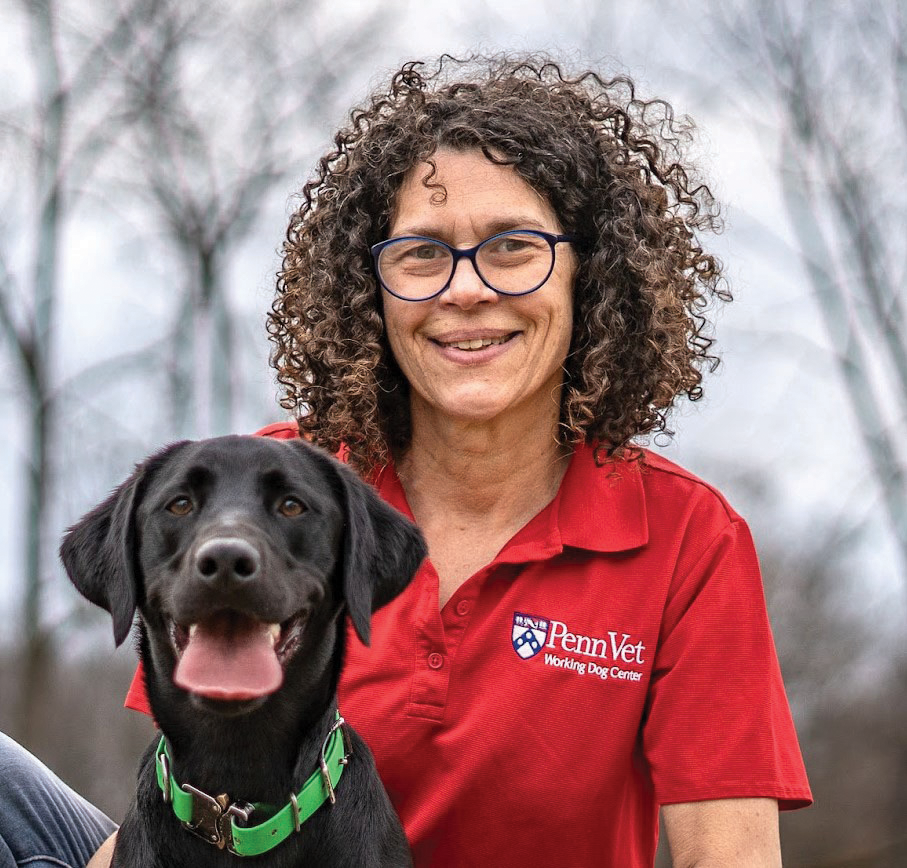
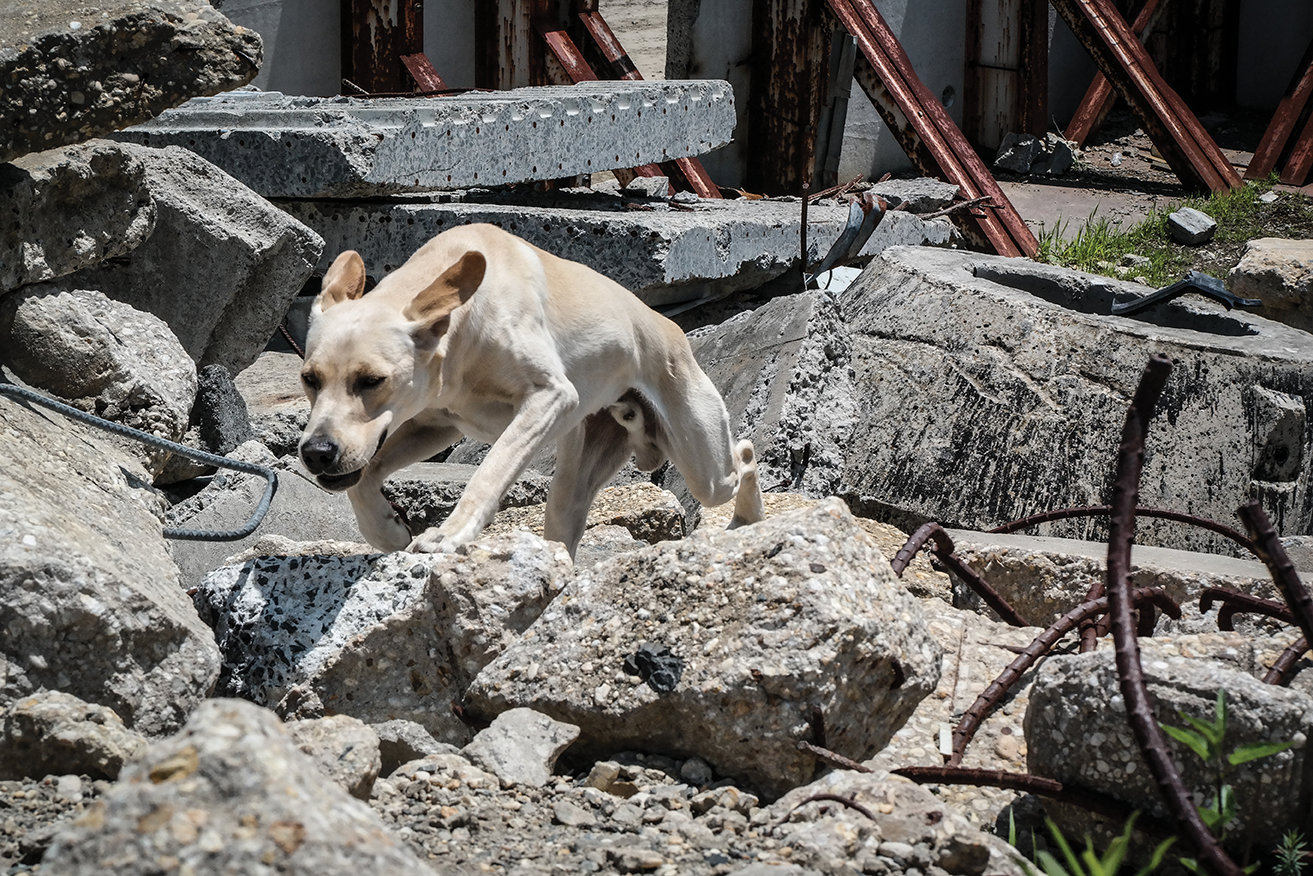
LEFT: Executive director Dr. Cynthia Otto with her foster dog, Vauk RIGHT: A Yellow Lab named Packer trains in a rubble pile with the Penn Vet Working Dog Center. (Photos courtesy of Penn Vet Center)
How dogs are helping advance medicine and safety while also benefiting from new technologies
For Pennsylvania veterinarian Dr. Cindy Otto, the eight days she spent at Ground Zero after 9/11 became a defining point in her career. Working the night shift, she provided medical support to the search and rescue dogs, who spent hours using their keen sense of smell to identify victims trapped in rubble.
Working then as an assistant professor of emergency services at the University of Pennsylvania Ryan Veterinary Hospital, Otto continued to think about the 9/11 dogs, even shifting her research to focus on the science and health of rescue dogs. More than a decade later, those dogs inspired Otto and a team of veterinary specialists and university officials to found the Penn Vet Working Dog Center, a nonprofit research, education and training facility at University of Pennsylvania that partners with dogs to improve the health and safety of humans, animals and the environment.
“We call it the legacy of 9/11. We opened on Sept. 11, 2012 … We wanted to flip the script and really make a positive thing come out of a horrific event,” says Otto, the center’s executive director. “We’re really focused on these dogs having an amazing physical, behavioral and cognitive experience while they’re partnering with us to improve various parts of our lives.”
The Penn Vet Center is just one example of how the worlds of dogs and science and technology are intersecting, with dogs advancing science with their extraordinary olfactory sense, while technology and engineering are offering canines with medical issues a better quality of life.
Serving as a national research and development center for detection dogs, the Penn Vet Center aims to advance research and veterinary expertise to optimize the performance of scent detection dogs. Dogs are the perfect partner in research and training, Otto says. While other species may have strong olfaction, dogs communicate better with humans. Cats, for example, have a keen sense of smell, but are harder to train.
“We focus on how dogs use their noses and how they use their noses to collaborate with us,” says Otto, now a professor of working dog sciences and sports medicine at Penn’s School of Veterinary Medicine. “There are so many things in our world that we can’t perceive because we don’t use our noses in that way. We don’t process that information, and so dogs can tell us that information.”
At any one time at Penn Vet, 25 to 30 dogs are trained in search and rescue in a year-long program. The dogs, mostly Labs and German Shepards, come to the center at eight weeks old, donated from breeders or bred at the center, and attend school five days a week. Their classroom includes an outdoor agility yard with jumps, tunnels and climbing ladders, as well as a large rubble pile of broken concrete, pipes, wood and even a school bus. A trained dog can quickly identify someone trapped in a rubble pile or drowning in water, while it would take humans and equipment hours, Otto says.
“Every time I see it, it’s a miracle, let alone the other things that they can help identify like explosives, narcotics, contraband, diseases,” she says.
The dogs are also trained in medical bio detection to identify cancer, bacterial and viral infections, and environmental threats. For example, the canines can identify the Spotted Lantern Fly and prion disease, a devastating condition in wild and captive deer, based on the odor of their feces.
When the dogs graduate, most are sold to agencies to work either in search and rescue or patrol and scent work. More than 200 dogs have graduated. Some remain for research in areas such as disease detection, canine sports medicine and dog behavior.
The center recently finished a study on canine hemangiosarcoma cancer in dogs, a common and fatal cancer of the blood vessels of the liver, spleen and heart that is difficult to diagnose until it is too late. The center trained dogs to tell the difference between blood samples from dogs diagnosed with hemangiosarcoma versus dogs that are healthy or have other diseases.
“There are so many things that we don’t even think about that could be revealed through odor, like the fact that diseases have unique odor signatures that dogs can differentiate,” Otto says. “Dogs tell us it’s possible to do these things, and now we have to try and take that technology and get sort of as good as dogs.”
Tech for Dogs
Technology is playing an important role in helping dogs live better lives, too. A team of students at Rice University used haptic technology to help a blind dog safely navigate the world.
Kunde, a Houston dog, lost his vision to advanced glaucoma. For blind dogs, everyday life is dangerous, and they suffer bumps and bruises by simply walking around the house. Traditional solutions like rigid “halo” frames and Elizabethan cones can be bulky and uncomfortable, making it difficult for pets to socialize and play.
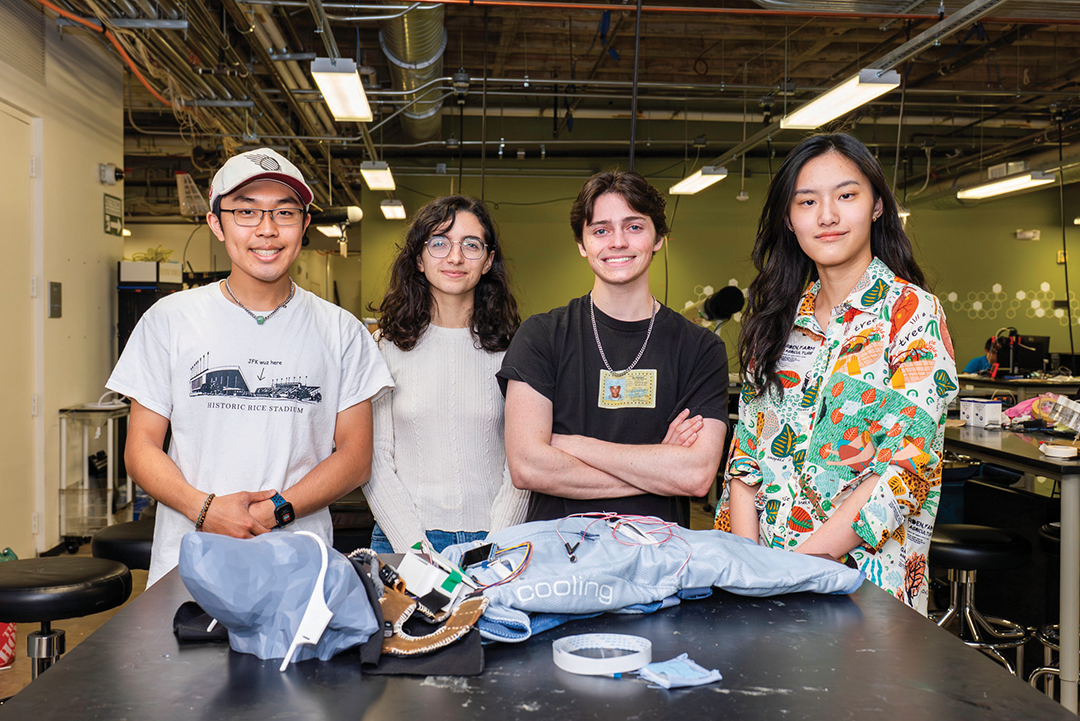
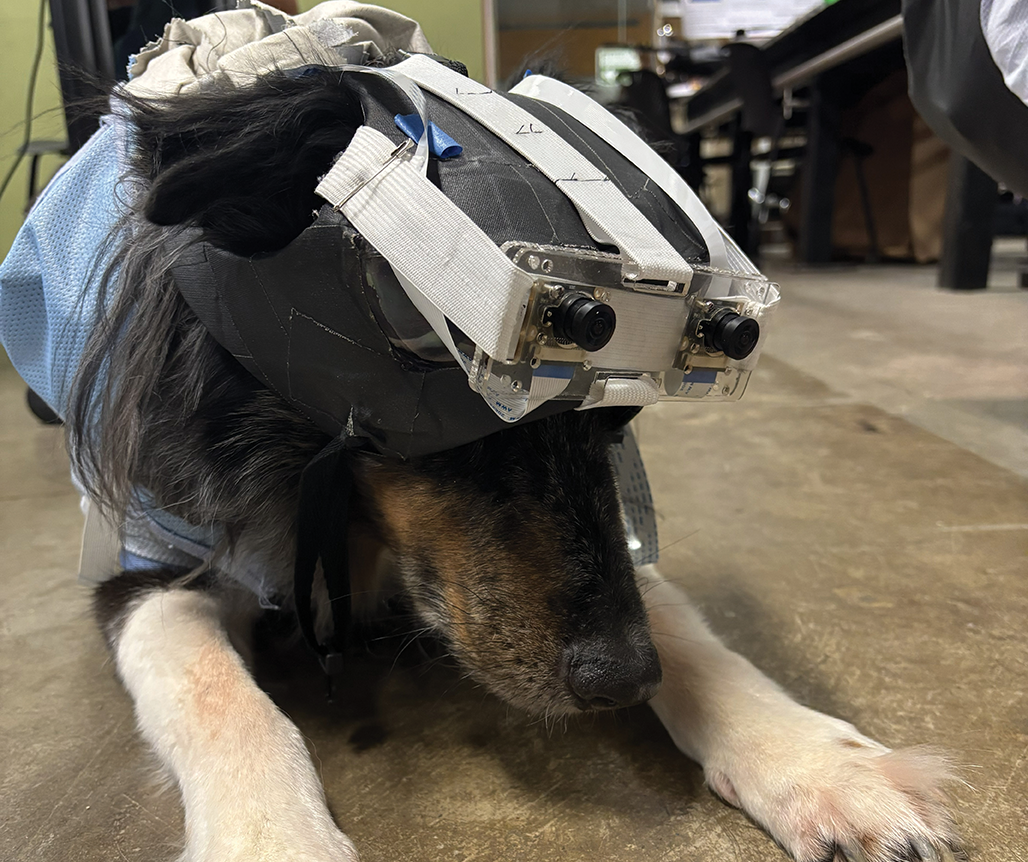
LEFT: The Kunde’s Friends team: Adam Vuong, Cristiana De Sousa, Santiago Brent and Issy Tsai. RIGHT: Kunde the dog has a team working to improve his life. (Photos courtesy of Rice University)
Kunde’s owners, Grant Belton and AJ Price, reached out to the Oshman Engineering Design Kitchen, Rice’s engineering design maker space, for a better solution. For their Engineering Design course last year, Rice students Adam Vuong, Cristiana De Sousa, Issy Tsai and Santiago Brent created a lighter and more comfortable alternative. Known as Kunde’s Friends, the team designed a wearable vest that uses haptic feedback powered by a stereoscopic camera system to give real-time spatial awareness without restricting movement or play.
“For those [traditional] products, their main intention is to prevent the dog from getting hurt, but not really for the dog to navigate on its own,” says Sousa, a senior mechanical engineering major.
The team created a vest fitted with linear resonant actuator motors commonly used in wearables and smartphones that vibrate to alert the dog when obstacles are nearby. A set of stereoscopic cameras mounted near the dog’s head captures real-time depth information.
“Kind of like giving Kunde a second set of eyes, the cameras create a depth map,” says Tsai, a sophomore electrical engineering major. “The closer an obstacle is, the stronger the vibration on that side of the vest.”
The team worked through many variations, experimenting with fabrics that kept Kunde cool but were strong enough to hold electronics and allow easy movement. Preliminary testing showed that the vest fit well and that Kunde felt and reacted to the vibrations.
“Studies have shown that different animals, even blind mice … that are using this sort of navigational, wearable technology are able to learn and navigate mazes,” explains Brent, a senior majoring in electrical engineering.
Such wearable haptic technology can also help humans who are blind and deaf or have physical disabilities, allowing them to navigate the world autonomously.
“If we have the right sensing technology and the right feedback technology that is sensible to humans, whether it be vibration motors or auditory technology or otherwise … then this technology can go very far,” says Vuong, a senior majoring in bioengineering.
Protecting Niblet
Technology literally saved the life of another dog last July, with help from the engineering department at University of Tennessee Chattanooga. The puppy, a 10-week-old, 2.5 pound Chihuahua rescue named Niblet, was born with an open fontanelle — the soft spot on the top of the skull where the bone hasn’t fully formed. The condition would make even the simplest household accidents potentially life-threatening for the puppy. If a solution wasn’t found in one week to make Niblet suitable for adoption, the puppy would have been euthanized.
The Humane Educational Society tapped into their connections at UTC’s engineering program in hopes of creating something to protect Niblet’s head. UC Foundation Associate Professor Trevor Elliott enlisted the help of Connor Mackey, a graduate who had strong 3D printing skills.
“3D printing is something I had been doing, so that was just the obvious hammer to the nail kind of solution,” says Mackey, now pursuing a Master of Science in mechanical engineering.
They scanned Niblet’s head with a 3D scanner to get a shape to digitize. Mackey used that file to design a helmet that he printed using flexible material. After a few more prototypes, they created a protective helmet that fit, allowing Niblet to be adopted.
The project wasn’t over. Niblet’s new owners, who renamed him Wrexham, asked Mackey to adjust the helmet as their puppy grew. Over a year, Mackey created about 30 iterations of the helmet, from adjusting existing 3D models of Wrexham’s head to experimenting with computer-aided design programs to build models from scratch.
He visited Wrexham every few weeks to test new prototypes. The final design is sleek and open around the ears, and more flexible than earlier versions. Mackey used an Apple Watch band for the strap, which was softer on Wrexham’s chin and easy to replace.
Wrexham’s owners can make replacement helmets if needed, after Mackey helped them win a 3D printer through an online crowdfunding campaign. Wrexham’s helmet just scratches the surface of what 3D printing can offer animals, such as making a leg or other limbs, Mackey says.
“The current helmet should fit him for life,” he says. “It’s really cool that you can save a dog’s life using this kind of manufacturing process.” n
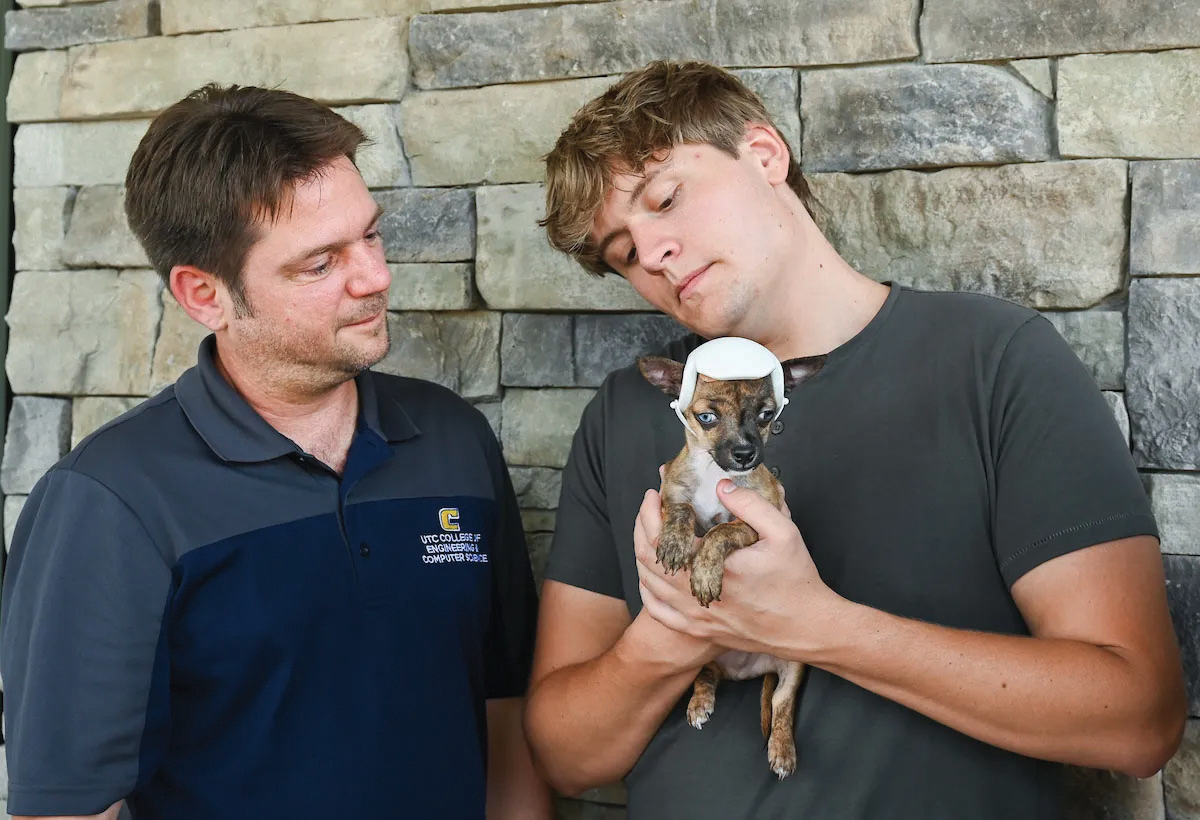
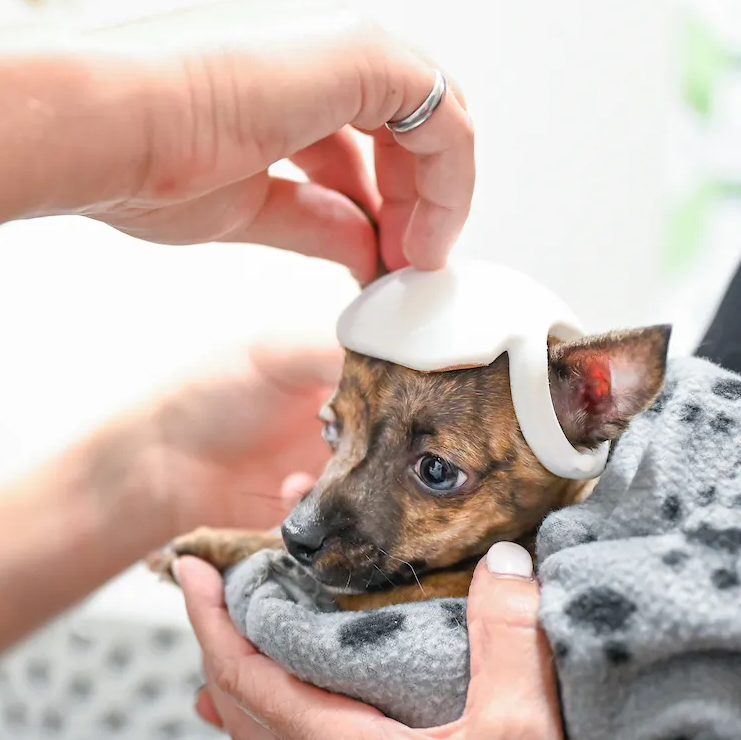
LEFT: Wrexham, as puppy Niblet, with UC Foundation Associate Professor Trevor Elliott and Connor Mackey. RIGHT: Wrexham tries on a helmet. (Photos courtesy of Connor Mackey and Trevor Elliot/UTC)