

Restoring the Reefs
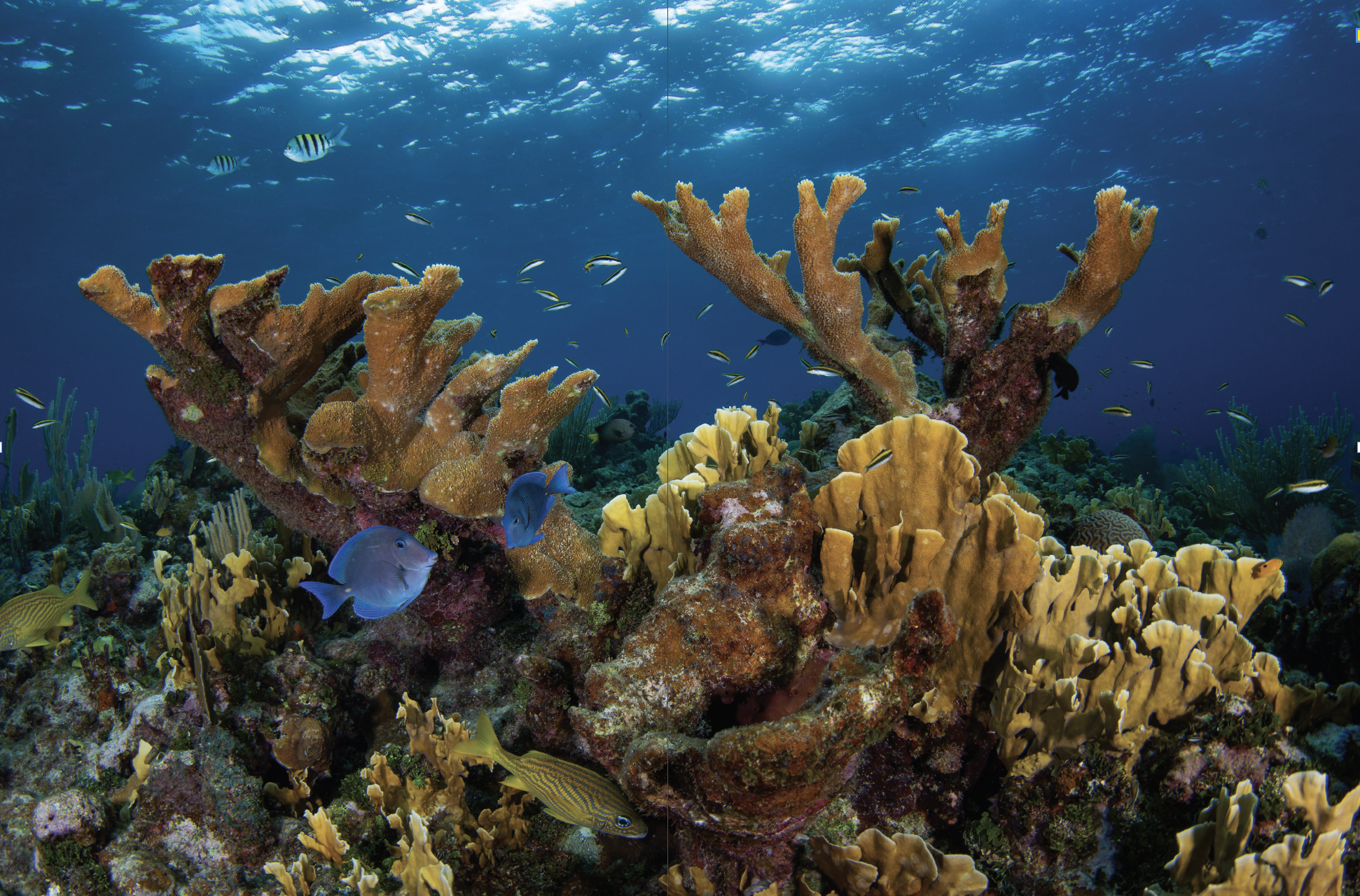
Healthy coral and blue fish off the coast of Honduras. (Courtesy of Andrea Godoy Mendoza/Roatan MarinePark)
Roatan Marine Park (RMP), a nongovernmental organization that co-manages the Bay Islands National Marine Park on the Mesoamerican Barrier Reef off the coast of Honduras, has historically been responsible for patrolling and protecting the waters and beaches around the island as well as maintaining the marine infrastructure. These duties include working with the Navy and other official groups to prevent or stop illegal or unsustainable practices within the protected marine area and keeping the waters safe and navigable.
While continuing to execute those duties and others, RMP now adds research and development to save and regrow the reef itself to its list of responsibilities. Through advanced biological research and coral regeneration techniques executed in a new state-of-the-art lab and in the surrounding waters, this important work is being conducted by the biologists at RMP in partnership with the California Academy of Sciences (CAS).
“A lot of people still think of RMP as the patrols program or the marine infrastructure program,” explains Andrea Godoy Mendoza, research program manager. “Those programs are still hallmarks of the organization. … We started [research] in 2019, originally with only asexual coral restoration,” a relatively simple way to regrow coral that already existed on the reef. At that time, although coral growth had already been steadily declining for more than 20 years due to climate change and other factors, asexual reproduction seemed to be sufficient to maintain existing species. “We weren’t really introducing any type of genetic diversity,” she adds.
Then, in 2020, a catastrophic outbreak of Stony Coral Tissue Loss Disease (SCTLD) quickly decimated an unprecedented amount of coral. “It’s like leprosy, but for corals, where the tissue literally just sloughs off,” says Godoy Mendoza. Closely following the SCTLD outbreak, in 2023 and 2024, a devastating bleaching event destroyed most of the coral that had survived SCTLD. A more innovative and aggressive approach to coral restoration was sorely needed.
Just prior to the bleaching event, in approximately 2022, RMP had begun exploring assisted sexual coral reproduction, a more complex and difficult type of reproduction, but one that introduces genetic variety to a region, increasing the chances of survival and growth. “It is a different level, requiring a very acute knowledge of coral biology,” Godoy Mendoza says, comparing it to the asexual reproduction that RMP had been previously implementing.
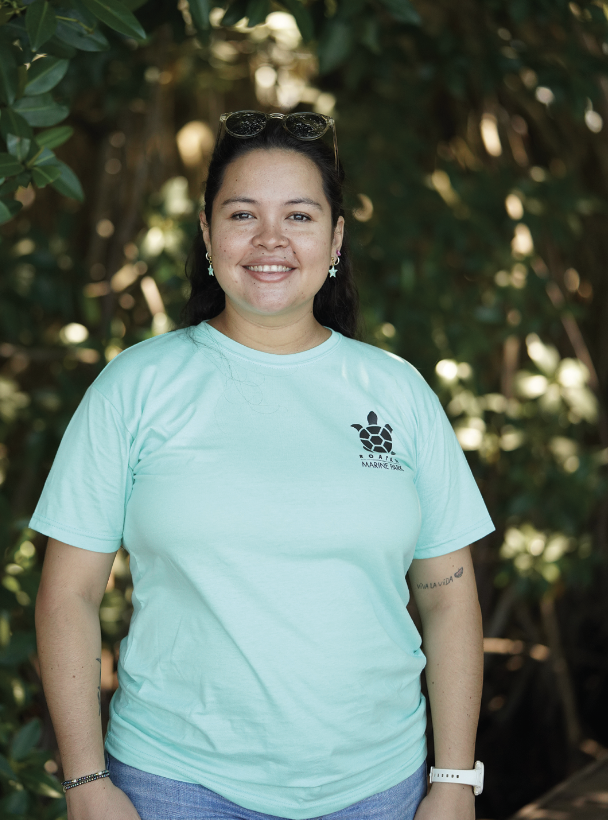
Andrea Godoy Mendoza
To conduct assisted sexual coral fertilization, RMP biologists must determine when coral will release their gametes or sex cells, requiring multiple late-night dives based on complicated analyses of the position of the moon, tides, temperature and other factors to determine an optimal window. Eventually, gametes are collected, mixed and placed into another container while biologists reproduce ocean-like waves and currents in containers. They are monitored for several days, and once fertilization has occurred and “coral babies” are produced, those babies continue to develop until they’re ready to settle on the reef, first released in the lab onto special structures, and then eventually out planted into the ocean.
All of this is now possible at RMP due in large part to a partnership with SECORE International, which has provided training, specialized equipment and the technical know-how necessary to predict coral spawning events. In addition, RMP partners with scientists at the California Academy of Sciences, including Dr. Rebecca Albright, associate curator and founder of the Coral Regeneration Lab there. “They are so advanced in their technology,” says Godoy Mendoza of CAS, adding, “but they monitor [the coral] in an aquarium. We implement those same techniques but in a wild Caribbean coral environment. That’s what we bring to the partnership — we’re testing it in the wild on the reef.”
In their San Francisco lab, CAS scientists apply four different genetic interventions to larval coral to increase their likelihood of survival in the wild, and now RMP scientists test those same interventions, starting in their lab and then continuing to monitor the young coral after out planting onto the reef.
“There is a 300 to 500% higher survival rate after being subjected to certain events than those in the control group. Those that haven’t been exposed to the interventions have not survived, while the ones that were exposed to the interventions do survive,” reports Godoy Mendoza.
“It is important that these types of initiatives come from the people that are facing the threats,” she says of the coral regeneration work at RMP. “To have seen the devastation in such a short period of time, I think it empowers me to know that there’s something I can do. If we lack maybe this technical expertise or some of the scientific knowledge, establishing partnerships is key because you do need the real-world experience and you also need the technical capacity, and that’s what the CAS brings to the table. They’ve taught us so, so much.”
Facing Challenges
RMP scientists are now actively involved in all phases of work and “not waiting on someone in a super developed country or laboratory far away developing techniques. We’re able to replicate them here. We’re the ones that are seeing the damage firsthand. Where all the damage is occurring, where all that loss is taking place, solutions are also coming from that place,” she adds.
The RMP lab — roatanmarinepark.org/crcr-lab is the first of its kind in Central America, and Godoy Mendoza stresses that it’s important to remember that it’s on Roatan — a small island on a reef that’s never been particularly well- known for its research or innovation. The creation of the lab was a huge accomplishment, and the successful work being done there is a testament to the teams of scientists working both on the land and in the water.
“We have gone through a full season of coral spawning work. It’s being used. All of the investment and all of the hard work that was required to have it there, we are making a lot of progress from it. We are implementing the interventions that the CAS designed, and we are putting resilient coral babies back on the reef. We have the ability now to have a positive impact on the reef.”
Still, ongoing challenges and hurdles to be overcome underscore the importance of remembering that this work is being done by a small team at a nonprofit in a developing country, and they need continued support. “The cost of maintaining the facility is incredibly high,” says Godoy Mendoza. The state-of-the-art facility required a new generator and new transformer as the island’s electric grid could not support running a reservoir, the multiple pumps needed to bring in ocean water, heaters to keep the temperature constant and so much more.
At Roatanmarinepark.org, people can not only learn about the organization, its partnership with CAS, and its work on coral regeneration, but also learn how anyone can make a difference, sometimes by doing something as simple as educating yourself and only using reef- and people-safe sunscreen, an important educational initiative for RMP.
“Educating yourself, volunteering, basically becoming involved and acknowledging that just because you don’t see something doesn’t mean it’s not a problem — that adds a lot to conservation efforts,” says Godoy Mendoza.
“From wherever you are, whatever you’re doing, you can have a positive impact. If you’re an artist, a poet, a communicator, a journalist … acknowledging that you can do a lot from whatever your field is, is very important,” she adds. “If more people don’t do that, we might be the last generation to enjoy reefs and witness what they used to be.”
To donate in support of research initiatives, visit roatanmarinepark.org/donate-rmp.