

Making Waves
Ishani Singh was surprised by what she found at her first science competition — or, rather, what she didn’t. She saw plenty of other young researchers presenting projects spanning computer science, AI and machine learning, but she didn’t see many other girls behind the posters, algorithms and code.
“It made me sad because I realized that girls may not be comfortable competing in these categories,” Singh says, “since there weren’t many of us, and we didn’t have that community to back and support us.”
So, the then-high school freshman decided to build her own: “That’s when I decided to create a community where girls could start learning the foundations of AI and then grow from that.”
Girls Rule AI, Singh’s AI-focused educational nonprofit, teaches girls the basics of AI through a series of virtual classes covering foundational building blocks like regression, neural networks and transformers. Classes are free and geared to learners 13 and older.
“My goal is to just spark their initial interest and help them feel more confident and supported as they explore the field,” Singh says. “I think with this, as long as they have a community to come back to and feel supported, they will be more comfortable going into the field and just trying new things.”
Learning to Teach
Girls Rule AI courses are split into basic and advanced sessions, each with three classes. The basic session gives an overview of AI and its applications, as well as linear and logistic regression and neural networks. The advanced session builds off this foundation and expands into natural language processing, transformers, ChatGPT and bias in AI. Hands-on coding exercises supplement each class and reinforce each skill.
Singh spent nearly a year developing the courses, which she also had reviewed by a data science
professor at Rutgers University and a software engineer at NVIDIA. Before founding Girls Rule AI, Singh had never developed lesson plans or coding exercises. And before her first class in the summer of 2023, she had never taught, either.
“I never actually thought I’d be a good teacher, but I realized that teaching a hard concept to someone means that I have to understand how they’re absorbing it, and I had to really dive deep into the topic itself,” she says, “so I’m not only teaching others, but I’m also helping myself really understand what’s going on. It’s kind of like a two-way thing. I’m helping them, but I’m also helping myself.”
In the two years since the first Girls Rule AI session, Singh has taught more than 200 girls in 25 states and seven countries, including India, Uganda and Afghanistan. There’s even a Girls Rule AI chapter in Kenya, led by a former Girls Rule AI student.
Many former students are now Girls Rule AI instructors, teaching assistants or chapter leaders themselves; one former student developed a primer lesson for Python coding, which she now teaches before sessions to get students more comfortable with coding before classes begin.
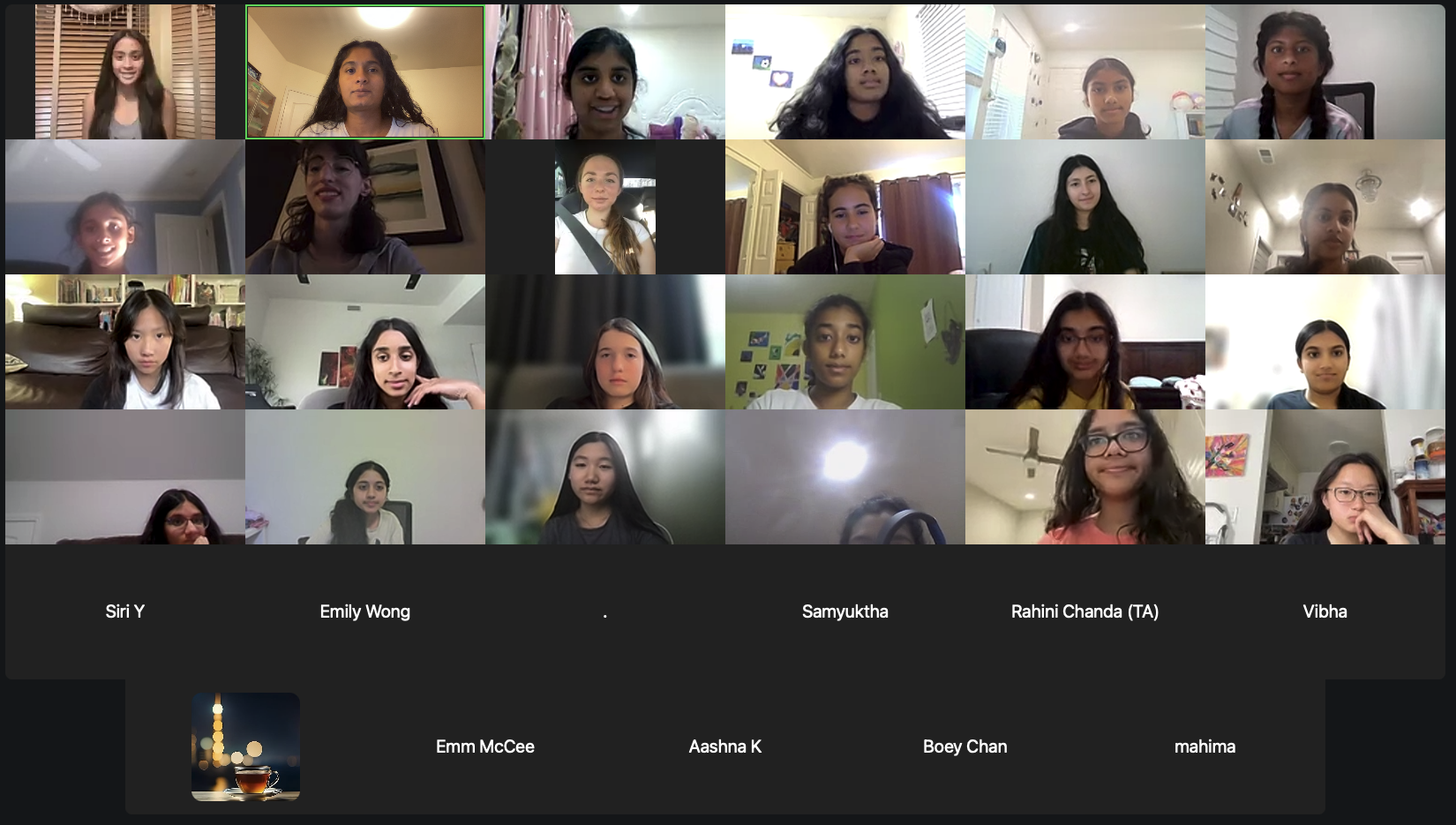
Singh works with a Girls Rule AI session
Singh is also considering expanding the Girls Rule AI curriculum to include other types of AI applications. While the advanced session currently focuses on mostly natural language processing, Singh is weighing adding another track for computer vision or audio processing and AI, both to give young learners more choices and potentially reach more curious students.
Mathematics of Language
The Girls Rule AI curriculum’s focus on natural language processing reflects Singh’s own fascination with the area. A recent graduate of the pre-engineering academy High Technology High School, Singh, now 18, is studying computing and linguistics at Yale University this fall, continuing a lifelong passion for math and logic.
“From the time I was little, I’ve had a very strong interest in math,” she says. “I started taking a lot of courses on the Art of Problem Solving platform, and through that, I became fascinated with probability, which is a very important aspect in AI.”
AI started gaining popularity when Singh was in middle school. Curious about the new technology and its connection with probability, Singh began taking AI courses on Coursera and designing small machine learning projects. At her research-focused high school, she continued exploring computer science, coding and AI applications.
“I also took a course with Dr. Rajiv Gandhi. He’s a professor at Rutgers, and he teaches the Program in Algorithmic and Combinatorial Thinking, and that’s a lot of the theory behind computer science,” she says. “There’s no coding behind it. It’s all algorithms and stuff like that. That was a very new experience for me, and I think I really just fell in love with the process and the algorithms behind the actual coding.”
Singh began developing increasingly complex machine learning programs. One program focused on analyzing and categorizing text by scanning TikTok comments to identify bullying content. Another program used transformer models and synthetic data generation to translate American Sign Language to English and vice versa.
Though their outputs are different, both projects used machine learning to quantify language — an idea that’s particularly fascinating to Singh.
“I mean, if you think about it, the backbones of these models are mathematical functions, yet AI is able to understand language,” she says. “How are you able to process language using mathematical functions? But AI is able to do it by converting all the words into vectors of numbers.”
“I think for me, that’s what I really fell in love with,” she continues, “and that’s mostly the things I’m teaching in the Girls Rule AI course.”
Though the session descriptions list things like neural networks or transformers, Girls Rule AI classes teach some intangibles as well — things like curiosity, confidence and creativity.
“I’m hoping these girls realize that they can do whatever they want with the knowledge that they get from this course,” Singh says. “They have a place in this field, and they can make waves in the world. But it’s just one step at a time.”