

Wired Couture
The convergence of fashion and technology is revolutionizing the way clothes are designed, made and worn. New 3D-printing techniques make it easy to customize garments and accessories with less material waste. Smart fabrics embedded with sensors can monitor health, change appearance and simulate human touch. And while these and other leading-edge creations haven’t quite reached the mass market yet, they are showing up in all kinds of spaces, from movie screens to sports and
music events to social gatherings.
Meet three trailblazing innovators who are working to bring tech-enhanced fashion from novelty to norm.
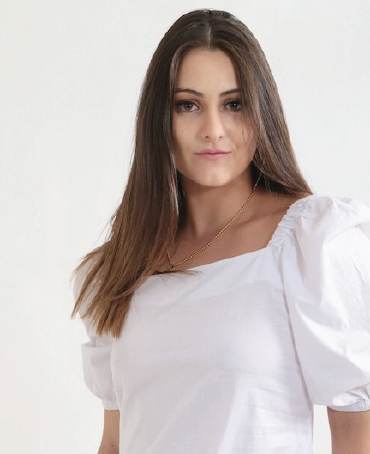
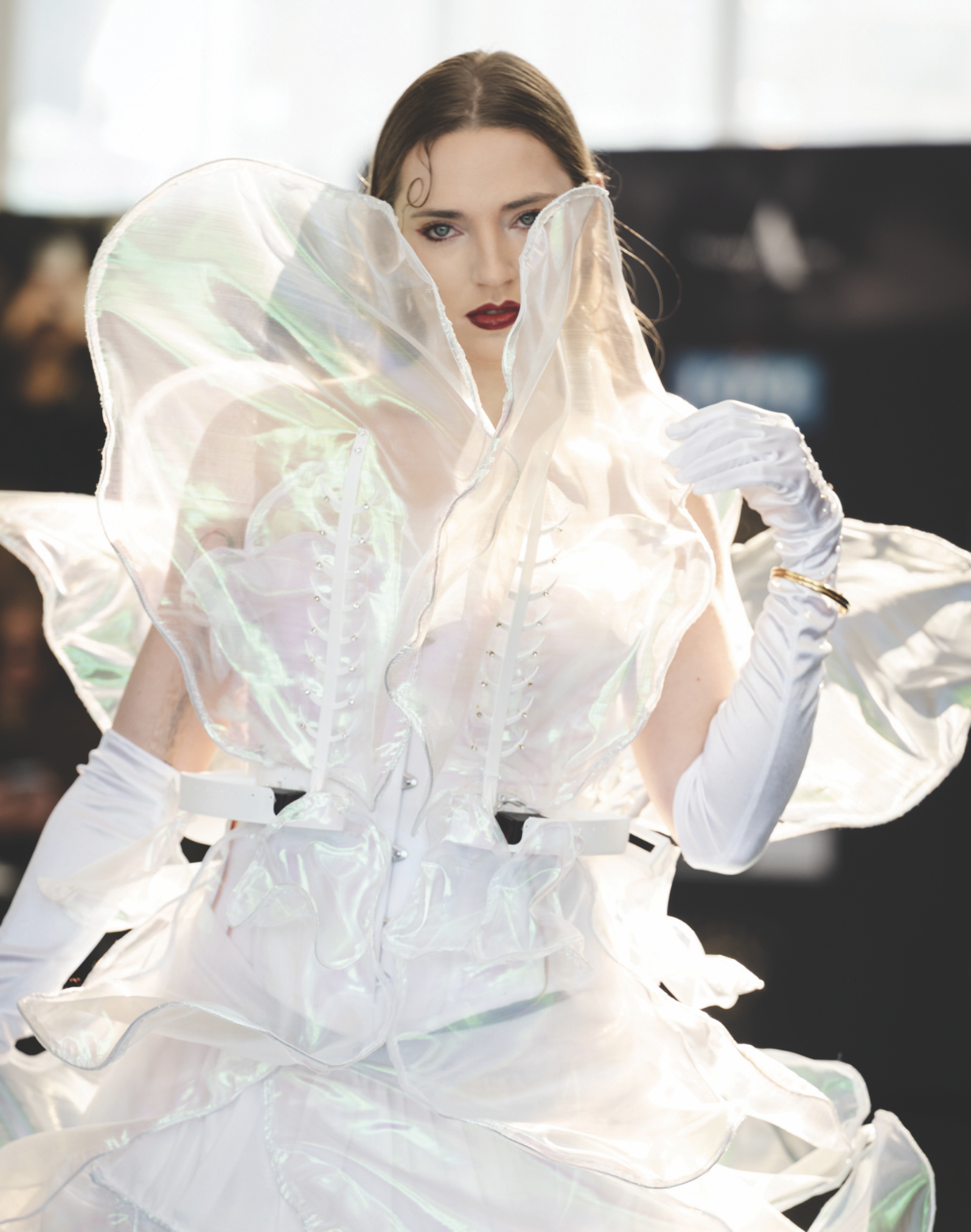
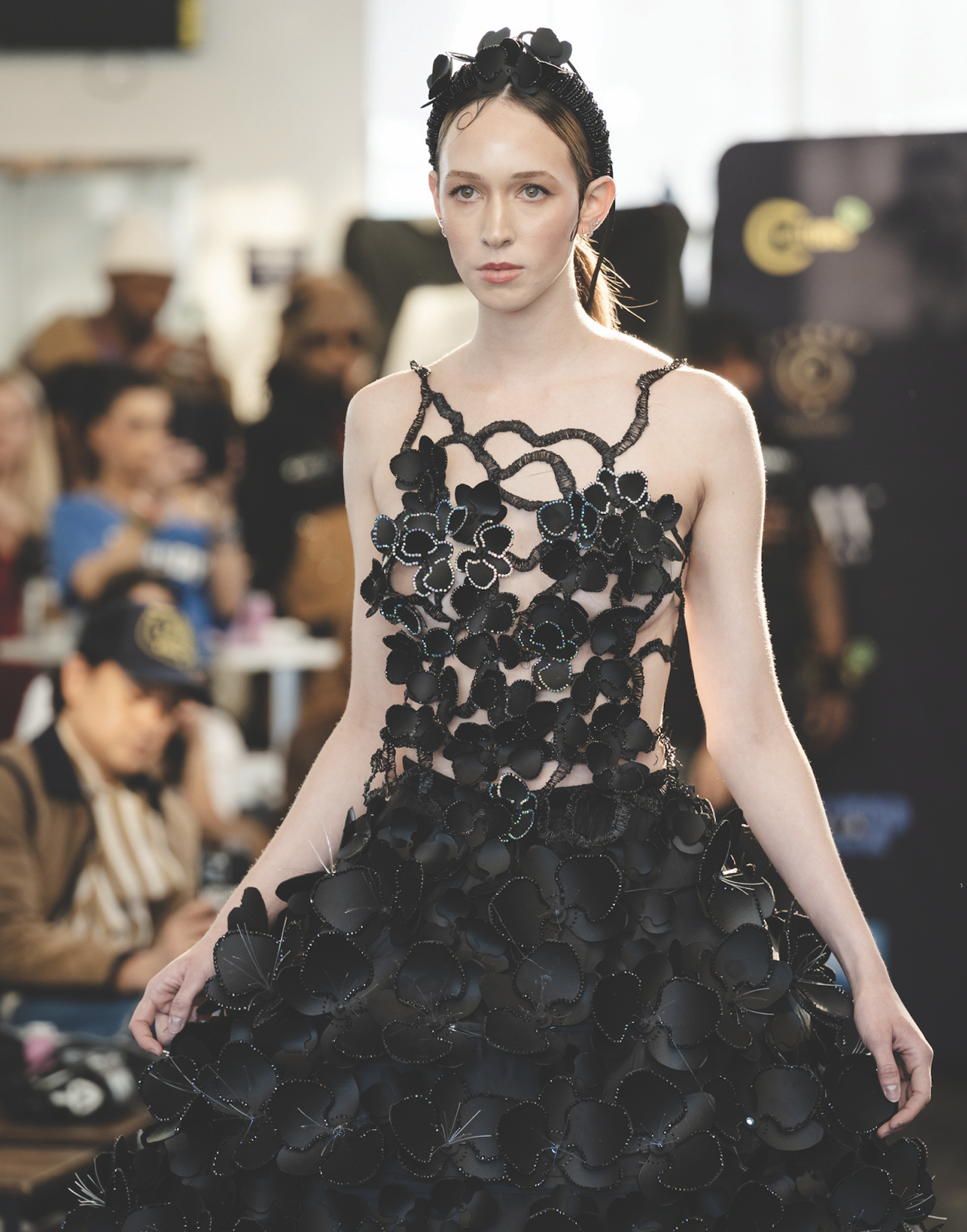
LEFT: Maia Hirsch, CENTER: Peace Offer is an interactive mechanical dress that blooms in response to a handshake, symbolizing connection and mutual understanding through touch. RIGHT: Hirsch’s Gazing Dress is wearable robotics” and responds to where viewers look.
(Left by Margaret Valera, Center and Right by Lauriane Ogay)
Maia Hirsch
At Cornell University’s Human Augmentation Physical Perceptual Interactions (HAPPI) Lab, first-year robotics Ph.D. student Maia Hirsch is researching how to improve the fit and grounding of wearable technologies made from fabric. Unlike smart watches and other rigid wearables, fabric easily loses its form, making it more difficult for sensors and actuators to fit and perform correctly. When cloth falls away from the skin and separates it from the embedded sensors, or when a tight fit presses them too close, it can result in inaccurate data readings, Hirsch explains.
The HAPPI Lab focuses on research on human-robot interaction and haptic perception, or the electronic transmission of the sense of touch, especially for medical and health care applications. Hirsch is working on a project that employs pneumatics — using compressed air to create motion or generate power — to replicate the physical sensation of a hug. She believes the key to moving this and other “cool prototypes” from the lab to widespread market use is to make their design visually appealing, not just functional.
“What I’m trying to bring to the table is that the aesthetic part has to be part of the design process,” Hirsch says. “It has to be part of the solution that we come up with. Nobody wants to wear these bulky, heavy, ugly things.”
Growing up in Caracas, Venezuela, Hirsch loved to draw, paint and do crafts. Political instability in her home country prompted her family to immigrate to Miami when she was 13, settling in a neighborhood where there were no other Latinos and no Spanish speakers, while Hirsch spoke no English at the time. The language barrier was less of a challenge for her in math and science classes, and she began to excel in those subjects. After two years in Miami, she moved to Panama, where she completed high school before earning a bachelor’s degree in mechanical engineering from Technion — Israel Institute of Technology. After the COVID pandemic arrived in the midst of her studies, she was back in Miami taking virtual classes when she got an opportunity to pursue the artistic interest she had earlier set aside. She landed an internship with a local fashion designer, going to the studio in the afternoons (Florida wasn’t on lockdown then) after attending online classes from midnight through the early morning.
By the time her full-time, in-person engineering studies resumed, Hirsch had developed a serious side interest in designing high fashion with mechanical and robotic components. She began posting her own tech-enhanced dress designs on an Instagram account. Last February at EDGE New York Fashion Week, a platform spotlighting fashion-tech startups, she exhibited one of her interactive dresses on a mannequin. Called “Peace Offer,” the garment is designed to look like a giant white flower, with petals that open via embedded sensors that respond to someone touching the wearer’s hand.
“People were literally in line waiting to shake the mannequin’s hand,” says Hirsch, who was back at NYFW 2026 with two of her creations — this time with live models donning them on the runway.
Hirsch’s interest in interactive clothing design stems partly from a desire to dispel the notion that technology is always a barrier to human-to-human connection. While acknowledging some of the concern is valid that tech can push people further apart, she insists that doesn’t have to be the case.
“I’m trying to show that not all the technologies are like that,” Hirsch says. “It can actually bring us closer together in some way, through curiosity or beauty.”

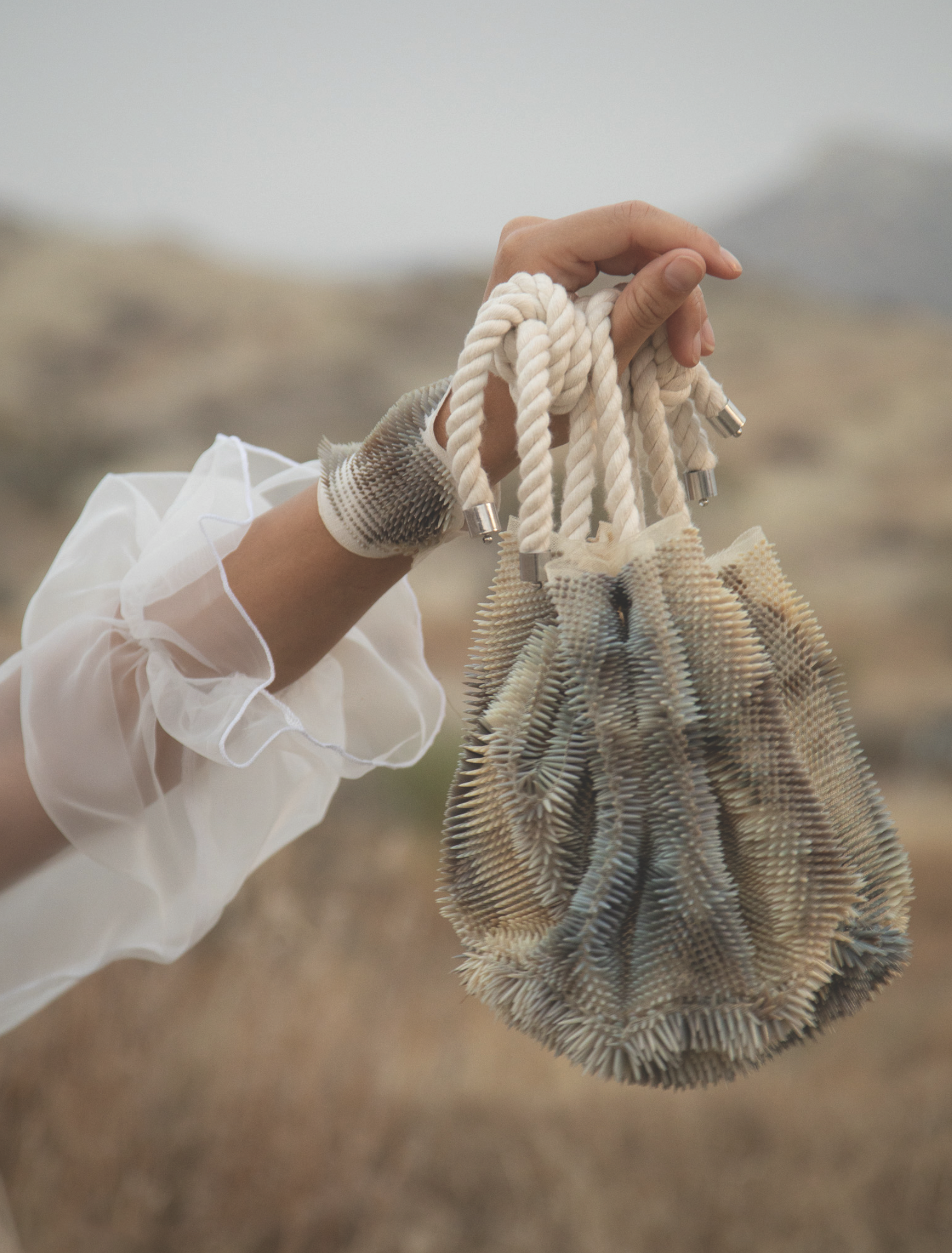
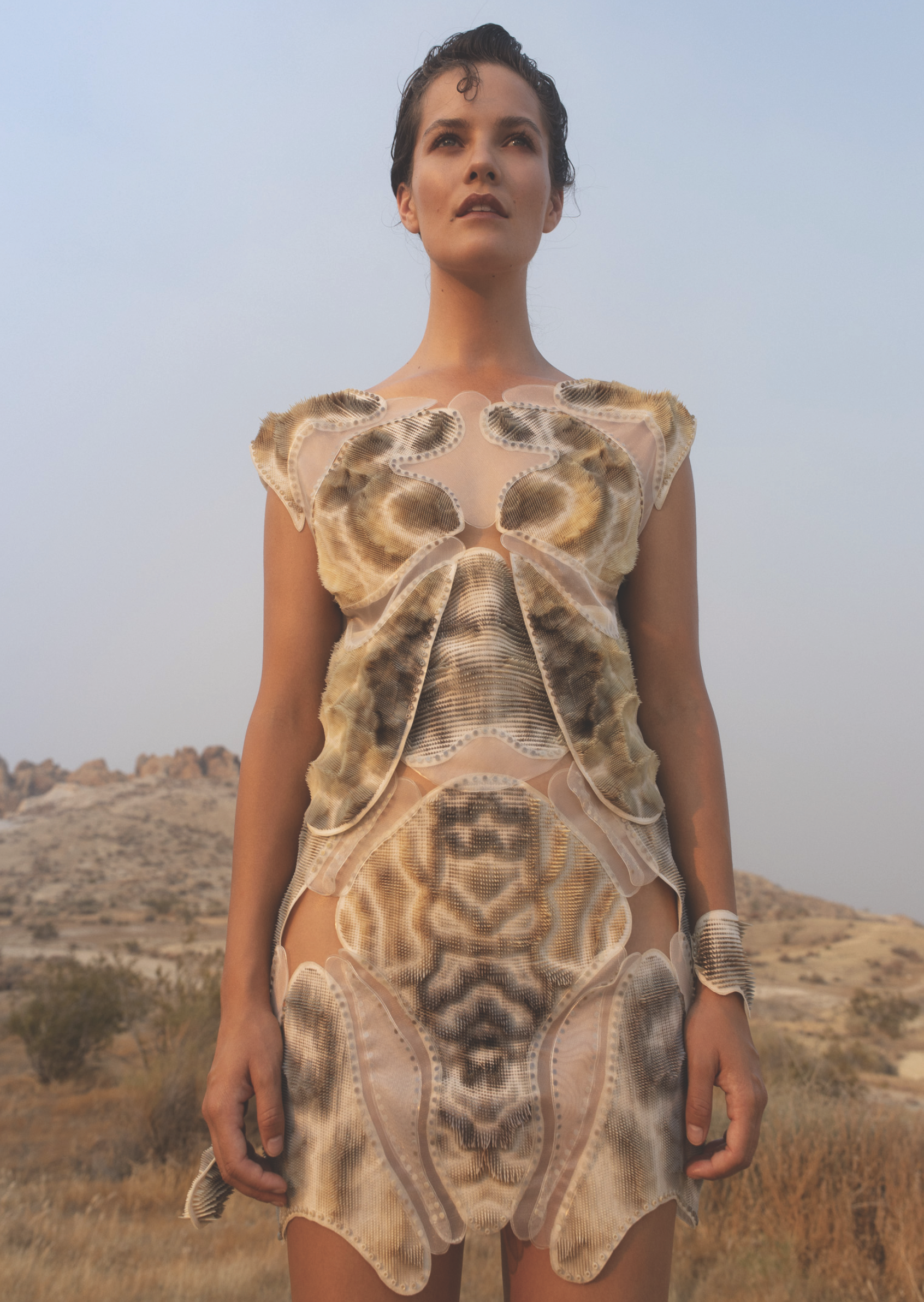
LEFT: Julia Koerner, CENTER and RIGHT: The ARID Collection, part of the Re-FREAM Project “Digital Vogue,” combines textiles with 3D-printed parts.
(Left by Pia Clodi; center and right by Ger Ger)
Julia Koerner
When film costume designer Ruth E. Carter and director Ryan Coogler were looking for someone who could help capture the Afrofuturistic theme of the Marvel movie “Black Panther” in the regal attire of Queen Ramonda, the work of Julia Koerner caught their eyes. Koerner is an award-winning architect, product designer and fashion designer who specializes in the application of 3D printing to design. In 2016, as they were beginning production on the first “Black Panther” film, Carter and Coogler took notice of Koerner’s design collaborations with haute couture houses in Paris and reached out.
Designing Queen Ramonda’s costumes took nearly six months, beginning even before Angela Bassett was cast in the role, Koerner says. The inspiration for the queen’s intricate crowns came from the traditional patterns of Zulu wedding hats, which Koerner digitized as 2D drawings and translated into a three-dimensional design.
The movie’s iconic costumes — for which Carter became the first African American to win an Academy Award for costume design in 2019 and garnered another award in 2023 for the sequel, “Black Panther: Wakanda Forever” — were integral to the story being told. But Koerner says she knew very little about the movie or its plot when she was working on the project.
“Everything was very top secret,” Koerner says. “I think this kind of approach also allowed me to be very free in my explorations and in the design, because I didn’t feel intimidated by the kind of bigness of what was coming, because I had no idea.”
Koerner, who custom designed a 3D-printed neck accessory Carter wore to Oscar-related events, also worked on the film “Captain Marvel,” with costume designer Sanja Hays, as well as other movie projects. But while her 3D-printing innovation may owe its widest recognition to the screen, the foundation of her interest in that design technology is in architecture.
Born in Salzburg, Austria, Koerner has master’s degrees in architecture from the University of Applied Arts in Vienna and the Architectural Association in London. When she completed her university degree in 2009, 3D printing in architecture was still in its infancy, but its use in product and fashion design was more advanced. Around that time, Koerner connected with Dutch fashion designer Iris van Herpen, who was interested in bringing 3D-printing technology to haute couture.
Since 2012, Koerner has been on the faculty in the Department of Architecture and Urban Design at UCLA, dividing her time between Los Angeles and Salzburg. In 2015, she started the fashion and home design firm JK Design GmbH, launching an entirely 3D-printed, ready-to-wear collection. The company’s online shop now features handbags, jewelry and home decor items. Koerner started the label with the mission to create more affordable fashion than what she typically created for haute couture runways and museum exhibits. She acknowledges that while her shop offers items that are less costly by comparison, they are still high-end.
“You will notice that the prices are still expensive, but that’s because it is something very unique and very new, and the design takes a lot of time,” Koerner says.
Koerner’s design aesthetic is inspired by the patterns of organic growth in nature, which she researches and incorporates into her work using a computational design method on the computer. And every project brings her roots as an architect to the surface.
“Whether I design a building, or I design a product with a certain function, or I design a dress, I always approach it with architectural design processes,” she says.


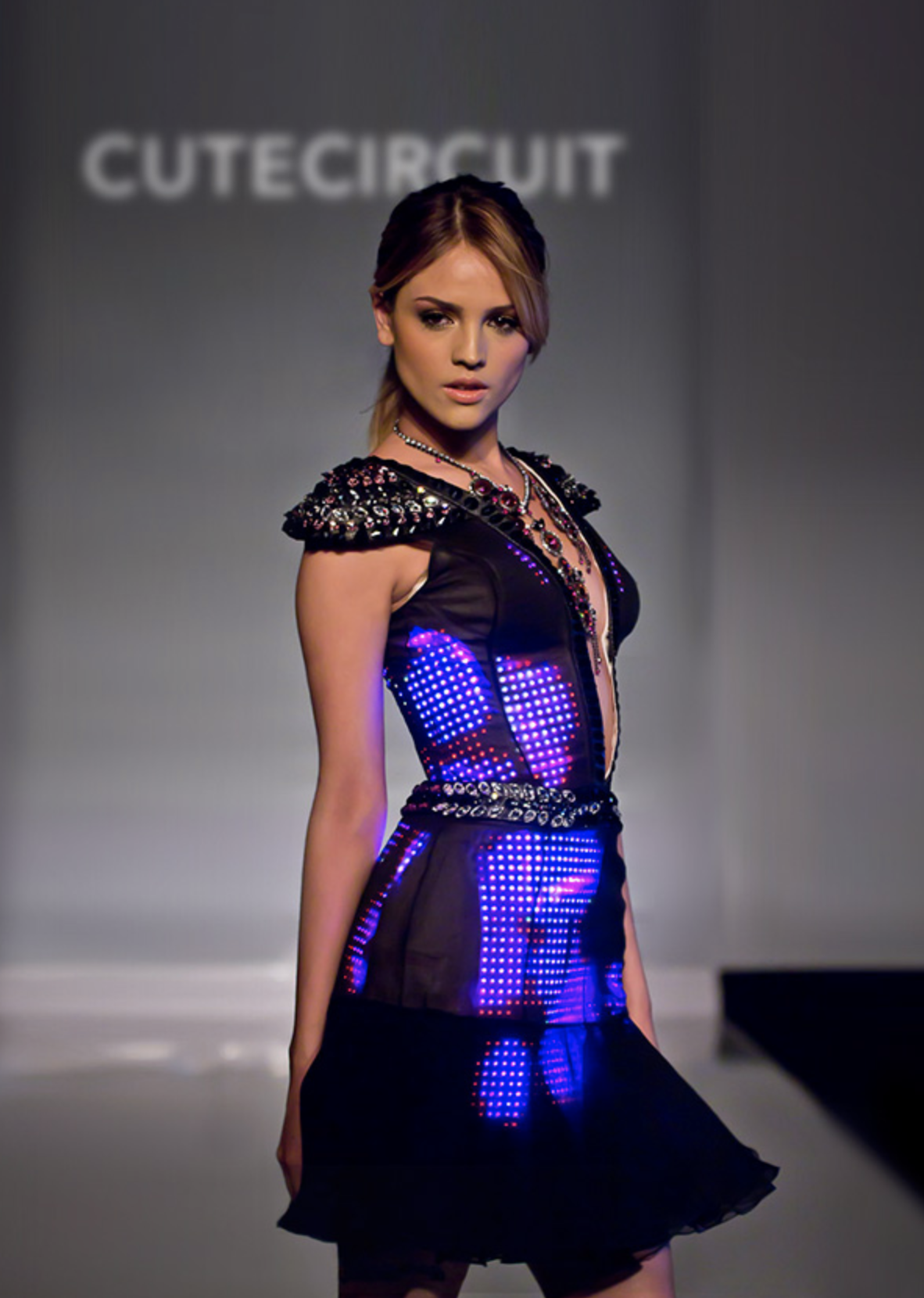
LEFT: Francesca Rosella, CENTER: Concertgoers light up wearing the SoundShirt by CuteCircuit, RIGHT: Actress Eiza González modeling an interactive LED dress on the runway for CuteCircuit
(Photos Courtesy of Francesca Rosella)
Francesca Rosella
Since Francesca Rosella co-founded the wearable technology fashion brand CuteCircuit in 2004, the company’s designs have won multiple patents, awards and other distinctions. In 2010, Katie Perry brought wearable technology to the red carpet for the first time when she wore a CuteCircuit gown to the Met Gala.
But the impact Rosella and her partner Ryan Genz have made in their field goes far beyond celebrity endorsements. Their garments are changing the way people experience sound, touch and social interaction. One of CuteCircuit’s most recent inventions, the SoundShirt™, captured the 2025 Webby Award in the category of best connected devices and wearables. Micro-actuators woven into the fabric of the shirt translate surrounding sounds — from music playing to sports fans cheering — into gentle vibrations the wearer can feel.
he SoundShirt™ is an evolution of the company’s 2002 HugShirt®, which delivers the sensation of an embrace over long distance by connecting the embedded sensors and actuators to a phone app. Designers determined the placement of the devices by mapping the positions of live demonstrators’ hands when they hugged each other.
The immersive experiences these garments create, whether the wearers are attending an opera performance, playing a video game or speaking to a loved one on the phone, have generated powerful reactions. Rosella says the clothes allow people to feel more included and connected.
Before starting CuteCircuit, Rosella, a native Italian, and Genz, originally from Maine, were working at an interaction research design institute based in Italy, with Rosella as a fashion designer and Genz as an interface designer and anthropologist.
“We were both interested in technology on the body and how people could connect to each other using devices that were worn on the body,” Rosella says.
Answering the call for a more sustainable, less wasteful way to manufacture clothes, their London-based company produced a collection of LED-laden garments that can change color, pattern and functionality with movement or the touch of a button. The idea was to make one adaptable outfit instead of several varieties, thereby reducing the use of materials and energy. Meanwhile, the wearer gains a more efficient way to be stylish.
“You could have a garment and download hundreds of visuals and animations, and then it will always feel fresh,” Rosella says.
CuteCircuit is preparing to spin off a recent project into a new company called Starlight, featuring an AI-enhanced device that attaches to clothing. Rosella describes the device as “a wearable social network.” People wearing the Starlight at events can connect to others with mutual interests based on data shared strictly between the devices.
For the team of Kenyan athletes at the 2024 Summer Olympics, the company created interactive sportswear on which fans at home could post encouraging messages right before a competition. Rosella explains that the fabric design was a stylized version of the traditional Maasai Shuka cloth, produced in consultation with Kenyan tribal leaders and the Kenya Olympic Committee.
“We did an anthropological deep dive into all the possible versions of how the cloth is worn, how it’s designed, what the colors are,” Rosella says.
CuteCircuit won the Grand Prix at the 2024 Loeries Awards — the premier accolades for creatives in Africa and the Middle East — for their design of the Team Kenya Olympic kit. But for Rosella, one of the best rewards of the project was hearing the athletes say how great the messages displayed on the clothes made them feel.
“I like this idea that people wear our garments and feel empowered,” she says. “Clothing makes people change their attitude because it confers power and makes them feel better about themselves.” n